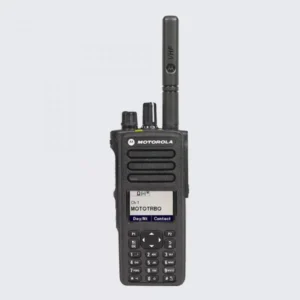
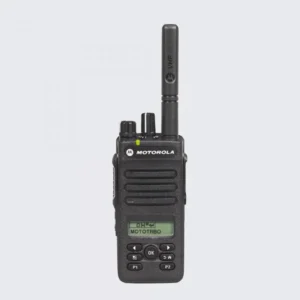
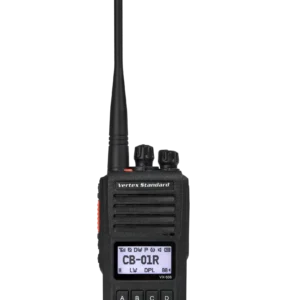
- Mission‑critical interoperability: APX radios support the widely used public‑safety standard APCO P25 — plus older analog systems and trunking formats — so they can communicate across agencies, departments, old and new systems seamlessly.
- Durability and ruggedness: Many APX models are built to meet military‑grade standards with robustness against drops, water, heat, and other harsh conditions.
- High-quality audio & adaptive noise suppression: APX radios use what’s often referred to as an Adaptive Audio Engine — dynamically suppresses background noise, reduces wind/ambient noise, and automatically adjusts volume to maintain intelligible voice communications even in chaotic environments.
- Security and encryption: They support multiple encryption standards and secure key management — crucial for sensitive communications in public safety.
- Flexibility and scalability: APX offers a wide range of models — from handheld portable units for field use to powerful mobile radios for vehicles. Agencies can pick devices based on roles while staying within a unified ecosystem.
What this means in practice: For first responders, public‑safety agencies, fire departments, EMS, or any organization that needs reliable, secure communications under pressure — APX delivers robust performance, reliability, clarity, and future‑proofing.
What to Know: Trade‑offs vs. Some Competitors / Alternatives
- Cost: Radios like APX — especially full-featured, all-band units — tend to be on the expensive end. Lower-cost radios (from other makes or simpler models) may do basic communication but may lack the full interoperability, encryption, or rugged build of APX.
- Complexity & Configuration: Advanced features (multi‑band, encryption, data, trunking) require proper setup and programming; agencies need trained staff or specialists to configure them correctly. For simpler use‑cases, this complexity may be unnecessary.
- Overkill for Basic Communication Needs: If you just need simple short‑range communication on a static site (e.g. a warehouse, small team, non‑emergency work), the full capabilities of APX may not be required — simpler, cheaper radios may suffice.
- Alternatives may offer value for money: Some radios from other brands (e.g. certain DMR radios, or radios focused on commercial/industrial use) might cost less, be easier to deploy quickly, and be adequate — albeit with fewer advanced safety or interoperability features.
For example, some industry comparisons of digital-radio manufacturers suggest that alternatives like Hytera or certain budget/commercial radios can be lower‑cost, and while they may sacrifice advanced mission‑critical features, they remain viable for non‑public‑safety tasks.
So — Which Radio Is Right for You? Quick Decision Matrix
| Your Use Case / Priority | Recommended Option |
|---|---|
| You need the highest level of reliability, encryption, multi‑agency interoperability, ruggedness — e.g. police, fire, EMS, disaster response, public‑safety work | High‑end APX (like APX 8000 series, or other full-featured APX models) |
| You need reliable communication but mostly within a single team or environment (e.g. security staff at a facility, small industrial crew, private site) | Mid-range or simpler radios (less expensive variants, or commercial-grade radios) — where advanced features are not essential |
| Budget is limited but you still need dependable two-way comms — no critical interoperability or encryption requirements | Entry-level commercial radios / lower-cost alternatives from other brands |
| You need a mix of mobility, data features (GPS, messaging, mapping), and rugged design for field operations with potential for expansion | Modern APX models with LTE/Wi‑Fi/data support — or other radios that support data + voice reliabl |
My Recommendation
If you are part of a public-safety agency, emergency services, large organization with multiple teams, or require strong security and cross-team coordination, APX radios are strongly justified. The investment pays off in reliability, clarity, safety, and long-term flexibility.
If your operations are small scale, non-critical, within a single site or facility, and security/interoperability is not a concern, you might save money with simpler/commercial radios — but make sure they meet your basic communication needs (range, clarity, durability).

